In precision manufacturing, which is the final determining factor in the ultimate quality, production cost, and delivery cycle of parts, the choice of machining process makes a direct difference. Faced with parts of diverse structures or functions, manufacturers have to decide whether to use CNC milling or CNC drilling. Although both of these popular CNC machining processes fall into the category of subtractive manufacturing, they are significantly different in technical principles, machining operations, and conditions of usage. Incorrect choice can lead to poor accuracy, delayed delivery, and unjustified cost increases.
LS Manufacturing, in its extensive technical expertise, strives to demystify the intrinsic differences of CNC milling and drilling for its clients. Whether mold pieces with complicated cavities or joining plates with multiple holes, LS Manufacturing can provide customized best process solutions, ensuring every part is uniquely shaped in the most cost-saving, efficient, and reliable way to meet precision requirements.To save you time, here’s a quick overview of the core conclusions.
CNC Milling vs CNC Drilling Quick Reference Table
| Comparison Items | CNC Milling | CNC Drilling |
| Core Functions | Contour Forming: Milling the workpiece with a turning cutter to create material removal for intricate three-dimensional features such as planes, curved surfaces, grooves, and cavities. | Hole Machining: Specifically designed to create or expand round holes in solid material. |
| Tool Movement | Turns and can move in three or more axes (X, Y, Z) simultaneously for multi-axis simultaneous cutting. | The machine primarily performs the reciprocating feed motion along the spindle (Z-axis). |
| Machining Flexibility | Highly flexible. One machine can carry out a number of complex operations with satisfactory versatility. | Specialized. Single-purpose dedicated to hole machining with high efficiency but single purpose. |
| Primary Applications | Molds, housings, cams, and complex parts cavities and shapes. | Bolt holes, pin holes, and through holes in flanges, mounting plates, and other parts. |
| Core Advantages | Very versatile and can produce complex geometry. | Very productive, offering rapid, low-cost, high-accuracy hole cutting. |
| Select the Key | With any non-circular features, curved surfaces, or cavities on parts, utilize milling. | When the key machining requirement is rapid and accurate circular hole creation, utilize drilling. |
| LS Manufacturing Value | Provide customers with the best process solutions to realize cost-effective and efficient perfect forming of complex parts. | Maximize multi-holed parts’ machining efficiency and hole position accuracy at minimum cost. |
Briefly, milling is to “shape the shape,” and drilling is to “make the hole.” LS Manufacturing applies its expertise to match process and part demands hand in glove, to the best mix of quality, cost, and efficiency.

Why Trust This Guide? Real-World Experience by LS Manufacturing Professionals
This guide’s expertise lies in LS Manufacturing’s long heritage. We don’t operate on theory alone; we are supported by decades of high-volume production experience in precision. The company has served challenging industries such as aerospace, automotive, medical, and high-end consumer electronics for a long time, working with tens of thousands of complex and diverse product drawings and processing specifications.
This everyday quest for ultimate precision and productivity compels our process team to precisely model every detail, from material dynamics to machine tool behavior, from toolpath optimization to tolerance management, thus creating a science-founded and strict process decision-making system. This book is the result of this established knowledge system.
Most importantly, all the conclusions of the guide are verified in practice. It’s a direct outcome of our engineers’ prudent decision-making and learning from pulling out extreme part machining issues from our customers, i.e., between milling or drilling usage. We totally understand when an apparently viable milling solution can inflate costs; and we totally understand when ultra-accurate milling is what’s necessary to uphold the positional accuracy and surface finish of an asymmetrically shaped hole.
These insights derived from actual production make this guide more than a theoretical textbook, but a practical, real-world guide that can be directly applied to avoid errors and create value.
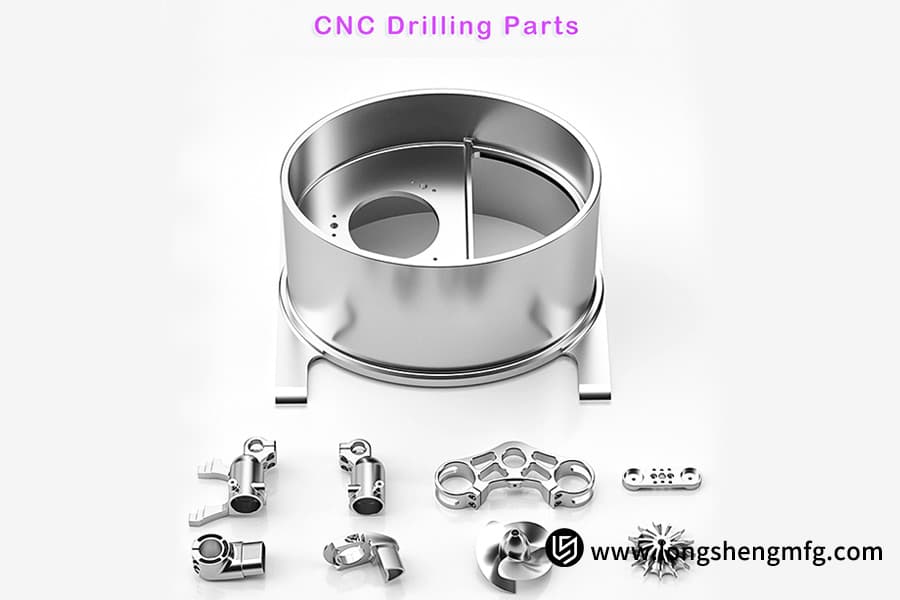
What is the key difference between CNC milling and drilling?
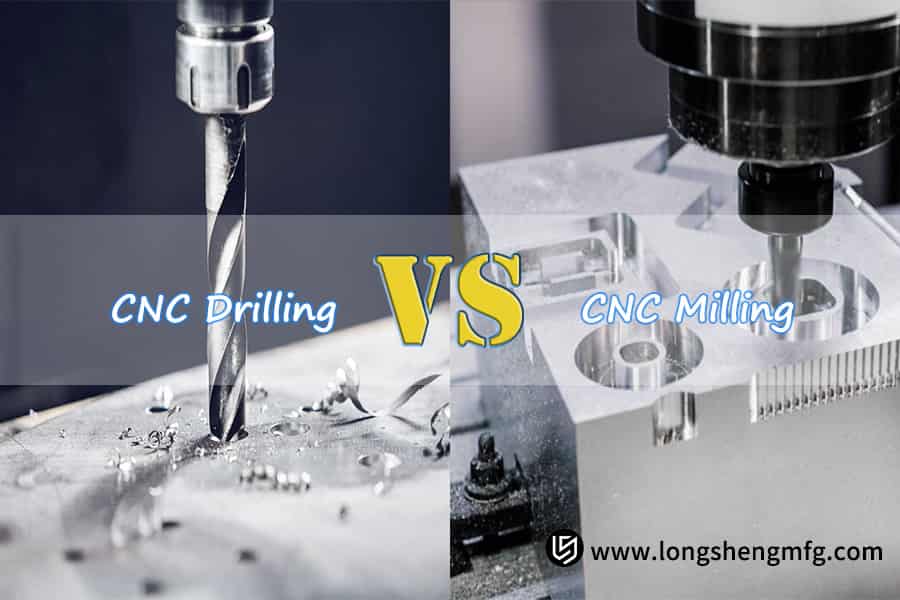
The difference between CNC milling and CNC drilling lies in their basic objectives and application methods. To better explain the main technological contrasts between milling and drilling, the basic contrasts are contrasted below:
| Comparison Dimensions | CNC Milling | CNC Drilling |
| Core Objectives | Contour Shaping: Creation of complex forms, such as planes, curved surfaces, and cavities. | Hole Machining: Designed to produce holes of circular shape. |
| Motion Methods | Multi-axis Linkage: The tool rotates and can move in a number of directions such as X, Y, and Z for cutting. | Axial Feed: The tool mainly moves linearly along the spindle axis (Z-axis). |
| Material Removal Mechanism | Multi-dimensional Cutting: Utilizing side or end cutting edges of the tool for layered, contour-dependent material removal. | Unidirectional Penetration: Relying on the centering of cutting edge and drill point for axial compression and ejection. |
| Machining Flexibility | High: One machine can carry out a compound series of processes, highly adaptable. | Specialized: Extremely effective, but dedicated application is to machining circular holes. |
An understanding of the inherent nature of milling and drilling operations serves as the foundation for the proper selection of process. The expertise of LS Manufacturing stems from understanding precisely when to use milling to “3D engraving” and when to use drilling to “efficient hole making,” thereby producing the best cost-efficient and reliable solutions for its clients.
When is CNC milling a necessity?
In the planning of part machining, it is necessary to understand when to employ CNC milling. When part geometry goes beyond simple circular holes, with specific shape, contour, or three-dimensional form demands, CNC milling is a necessity. Specifically, CNC milling must be chosen in the following critical circumstances:
- When complex contours are machined: Drills cannot operate when there are non-circular irregular holes, keyways, or irregular edges on the parts. Only CNC milling, by means of the multi-axis linkage function of the milling cutter, can accurately machine these complex contours.
- When machining cavity, three-dimensional surface, and precision step: Be it the curved surface of a mobile phone shell, a mold cavity, or precision step surfaces of varying heights on a device panel, these features require the cutting tool to cut freely in three-dimensional space. This just so happens to be milling’s greatest advantage—by cutting in layers, perfectly transforming a three-dimensional digital model into a solid part.
- For extremely high dimensional accuracy and surface finish applications: Milling yields superior dimensional tolerances (e.g., ±0.01mm) and surface finish than drilling. Milling is a requirement for areas that require high fit or aesthetic precision.
When your design specifications go beyond simple “drilling” to any form of “shaping,” the time is right to switch to CNC milling. LS Manufacturing, through its extensive experience in complex contour machining and precision component creation, rightly recognizes such crucial instances, guiding your complex parts to achieve an ideal finish.

How are the advantages of CNC drilling realized in batch hole machining?
In multi-hole part manufacturing, CNC drilling is the key to achieve high efficiency and low cost. Its advantage is particularly demonstrated in batch hole machining tasks compared with other processes, which renders it one of the main approaches of LS Manufacturing in helping customers reduce cost and increase efficiency. The superiority of this high-efficiency drilling technology is reflected mainly in the following:
1. Superior machining efficiency and consistency:
CNC drilling machines can be fitted with multi-spindle heads or automatic tool changers, which allow all holes of the same or varying specifications in a component to be machined continuously and automatically in a single setup at very high speeds. The process being automatic reduces human intervention, and hence the position and size of the holes are maintained with very high consistency in a batch of components.
2. Deep hole and special hole machining capability:
For deep holes with large depth-to-diameter ratios, or special hole shapes such as stepped holes and countersunk holes, the CNC drilling equipment can select special drill bits (such as gun drills) and fixed cycle programs (such as pecking drill cycles), effectively solving the problems of chip removal and heat dissipation, and ensuring the quality of the hole wall and perpendicularity—results that are difficult to achieve consistently with ordinary milling.
3. Reduced production cost and cycle time:
For pure hole machining demand, the application of specialized drilling operations obviates the need for more expensive multi-spindle milling centers, directly saving equipment time cost. Meanwhile, its simple programming and short cycle time directly reduce the batch hole machining overall delivery cycle.
When hole machining is the focus of production, CNC drilling is unbeatable in terms of efficiency, accuracy, and cost. LS Manufacturing makes full use of high-level specialized equipment and mature programming technology to achieve optimal efficient drilling solutions, so customers can gain optimum benefits in mass production.

How to Achieve Cost Optimization Through Process Selection?
In precision manufacturing, minimizing cost is one of an enterprise’s essential objectives, and the correct selection of processes is the most significant lever to achieve this aim. It is far more than a simple comparison of unit costs; it is a systematic concern project with processing efficacy, resource utilization, and ultimate economic benefit. A scientific decision model depends foremost on the following aspects:
1. Selection according to part features and batch size:
For small batches of complex-shaped parts, CNC milling of high flexibility is used, completing all operations (contouring and hole machining included) in a single setup, saving multiple setup costs and achieving better economic benefit. For large batches of sheet metal parts, primarily with round holes, CNC drilling of high efficiency and specialization is predominantly used, as its cost per hole is far lower than milling.
2. Trading machining time for equipment occupancy costs:
The cost of equipment time per unit of milling centers is generally higher than that for drilling machines. Therefore, it would be a tremendous waste of valuable equipment time to machine simple hole groups individually on a milling machine. It is a sound process decision to split the job: use a milling machine to machine complex cavities, and a drilling machine to complete all holes quickly, and in this way, increase overall equipment utilization.
3. Considering tool wear and programming efficiency:
Drilling is simple to program and low in tool cost; milling is complicated to program and higher in tool cost. In the situation of machining standardized holes, the use of drilling can successfully reduce tool and programming costs.
Cost minimization is possible through an integrated approach. LS Manufacturing provides this specialist process selection consultancy service. We create the most cost-effective hybrid process solutions by accurately assessing your part geometry, batch size, and accuracy requirements, ensuring each cent of your cost delivers optimum value.
Hybrid Machining: When Does Milling and Drilling Have to Work Together in Tandem?
In precision manufacturing today, when machining parts of a complicated structure, a single machining process falls short of simultaneously realizing a compromise between efficiency and accuracy. In such a case, the idea of hybrid machining—that is, making milling and drilling combine—becomes an essential method for achieving high-efficiency production. The advantage of such multi-process machining is particularly pronounced in the following specific cases:
1. Ensuring key position precision and reducing clamping errors:
On parts with complex cavities and extremely high hole position requirements (e.g., hydraulic valve blocks), traditional methods require transfer between multiple machines, and repeated clamping inevitably leads to cumulative errors. Through composite machining, high-precision milling of the cavity is completed in a single clamping, and then all the hole systems are machined based on the same datum, with clamping deviations completely eliminated and relative positions of the holes and the contours achieving micron-level accuracy.
2. Significantly shortening the production cycle and improving overall efficiency:
Integrating milling and drilling into a single advanced five-axis machining center, and achieving impeccable process connection through an automatic tool changer system. This eliminates the time spent on transferring parts between different machine tools, waiting, and secondary debugging, thereby shortening the overall machining cycle by more than 30%, which is especially suitable for the rapid delivery demand of small and medium lots.
3. Simplified production management and reduced total cost:
Multi-process machining simplifies complex processes in a single machine, significantly less work-in-process, tooling fixtures, and production scheduling complexity. Not only does it reduce equipment occupancy and logistics cost, but also reduces human intervention, which increases production stability and yield.
LS Manufacturing, with its multi-axis machining centers featuring advanced tool magazines and mature process planning, provides customers with one-stop composite machining services that are efficient and precise, achieving an optimum quality-efficiency-cost balance for customers.
How does LS Manufacturing achieve maximized process solutions for auto parts customers?
In the hyper-competitive automobile industry, the component manufacturers are being squeezed by the double vice of improving quality and reducing costs. LS Manufacturing, with its end-to-end process streamlining, provides customers with timely help.
1. Customer Challenge:
A customer, in machining aluminum alloy engine brackets, used the traditional sequential machining mode: milling the contour on one machine tool first and then moving to another machine for drilling and tapping. The model led to multiple clamping operations with repeated positioning error, and the product qualification rate had long been stuck at 85%. Meanwhile, the production process was complex and inefficient, significantly constraining order delivery abilities.
2. LS Manufacturing Solution:
By careful consideration, we came up with a solution of composite machining. First of all, we abandoned sequential machining and used a high-performance machining center to complete all processes in a single setup. The step-by-step sequence is as follows:
- Initially, one and only one positioning reference surface is precisely machined by a milling cutter;
- Then, from this source, continuous drilling and tapping of all holes are completed on one machine. Meanwhile, cutting parameters were optimized and a special fixture designed, and thus clamping stability and rigidity improved greatly.
3. Results and Value:
The new solution yielded fruits immediately. Through the elimination of repetitive positioning mistakes, the qualification rate of products increased by a remarkable 85% to 98%. The combined process shortened the processing cycle by 40%, significantly enhancing the production capacity. On the whole, this solution enables customers to save about RMB 150,000 in production costs annually, not only resolving short-term problems but also creating the groundwork for a long-term stable supply chain alliance.
LS Manufacturing, through scientific process optimization, exquisitely integrates drilling and milling into one machining operation, creatively transforming customers’ issues into competitive strengths and convincingly winning the battle in quality, efficiency, and cost.

How much do material properties affect milling and drilling selection?
Material properties are the scientific basis of decision-making in CNC milling and drilling processes in precision machining. Material hardness, toughness, and heat conductivity have direct effects on tool life, machining accuracy, and production cost. Based on rigorous analysis of material properties, LS Manufacturing provides customers with scientific process parameters and technical recommendations with a view to obtaining technical and economic optimization in machining solutions. Material Processing Characteristics Analysis:
1. Aluminum Alloys:
- Effect of Properties: Very poor hardness and good thermal conductivity but sticks to tools.
- Process Guidelines: Milling. High feed rate and high speed preferred along with a sharp end mill. For drilling, design for maximum chip removal in order to avoid burrs on hole edges.
- LS Manufacturing Expert Tip: We recommend a purpose-designed aluminum alloy cutting fluid that improves surface finish by over 20%.
2. Stainless Steel:
- Property Effect: Severe work hardening to a high degree, low thermal conductivity, and heavy tool wear.
- Process Guidelines: Light cut depth and medium speed should be utilized in milling. Cobalt alloy drill bits and pecking cycle should be utilized while drilling.
- LS Manufacturing Expertise Support: There is the potential for new tool coating techniques to make the tool life rise by 35%.
3. Titanium Alloy:
- Properties Effect: Highly chemical activity and low thermal conductivity with high tendency for easily chipping tools.
- Process Guidelines: Low-speed milling with continuous feed rate. Drilling using internally cooled high-pressure drill bits under careful control of cutting temperature.
- LS Manufacturing Expert Support: Build a special titanium alloy machining database to optimize the matching scheme of the three cutting elements.
Material properties directly affect the process boundary parameters of milling and drilling LS Manufacturing provides customers with full professional consulting on process parameter optimization, tool selection, and machining strategy development by setting up material-process-tool matching models, realizing maximal machining efficiency and economic value.
Choosing LS Manufacturing means choosing a precision machining solution based on a profound cognition of material science.
What are the determining factors of precision requirements on process selection?
Precision requirements are one of the most critical drivers of the choice of process in precision manufacturing. Different tolerance classes and geometrical specifications instantly determine whether to use CNC milling or drilling, posing a basic challenge to the firm quality control system.
The essence of precision machining is contained in the accurate response and assured satisfaction of these requirements. The dominant influence of precision requirements on process selection is partially realized in the following:
1. Positional accuracy and turning of holes:
If the hole cluster on a part has extremely strict hole spacing tolerances (e.g., ±0.02mm) or relative positional accuracy requirements, simple CNC drilling may be difficult to achieve due to limitations on equipment repeat accuracy. In this case, the ideal solution is to use a high-precision CNC milling machine. With one clamping, a high-precision positioning system is used to first complete the positioning of center drilling or milling of all holes, and drilling is carried out later, with positional accuracy right from the process source.
2. Shape Precision and Surface Finish:
For features with non-circular holes, non-round slots, or high surface finishes (e.g., Ra < 0.8 μm), drilling is not possible. CNC milling will be chosen, using toolpath optimization, precise cutting parameters, and potential downstream finish machining to rigorously maintain shape tolerances and deliver very good surface finish. This is an absolute advantage of milling in precision machining.
3. Quality Control System Support:
Not only equipment that is capable of achieving high accuracy but also adequate quality control in the process. LS Manufacturing makes allowance and compensates for dimensional deviations in real-time through in-machine measurement, precision tool setting equipment, and rigorous first-piece inspection procedures to ensure that each batch consistently meets the accuracy requirements of the drawings.
Accuracy specifications are the high expectation for selecting milling and drilling procedures. With the difficulty of high standards, LS Manufacturing, with a complete set of quality control system and profound precision machining experience, can design the most reasonable process routes for customers, converting design blueprints into accurate physical components.
How to Get Professional Process Scheme Advice
It is normal to feel lost while choosing a machining plan. LS Manufacturing is committed to allowing the clients to view a clear technical consulting path, whereby each project would start in accordance with professional process solutions and thereby ensure quality and control costs right from the beginning. You can achieve our professional help by following the following simple steps:
1. Requirements Communication and Document Submission:
You are only required to submit initial information such as 3D drawings of the part, technical requirements, and production batch size. Our engineers will use this as a reference point to perform initial feasibility analysis and process assessment, establishing potential issues and areas of optimization in the machining process.
2. Professional Solution Design and Analysis:
Based on your needs, our process group will begin in-depth analysis. We will examine thoroughly part dimensions, material properties, accuracy and efficiency requirements to design the optimal process sequence for you (such as milling and drilling composite machining), and deliver a full solution including equipment design, tooling concept, and approximate duration.
3. Free Detailed Quote and Consultation:
You will receive a clear process solution description and quotation. We offer complimentary technical consultation services, describing the solution details to you at your convenience, and tailoring it according to your feedback to ensure you understand and are satisfied with the solution entirely.
It is very convenient to receive professional help from LS Manufacturing. We have constructed a complete service chain from demand fitting to solution delivery for purposes of breaking technological barriers and attaining the highest project value for you by means of professional process solution consultation. You are free to call our technical support team for commencing a win-win collaboration.
FAQs
1. Can CNC milling perform drilling operations?
Yes, CNC milling machines can perform drilling operations through their spindles, offering high flexibility. However, for high-volume, standard round hole machining, dedicated CNC drilling machines have significant advantages in efficiency and per-hole cost. We will conduct a comprehensive evaluation based on your production volume and accuracy requirements to recommend the most economical and reliable solution.
2. How to determine whether a part is suitable for milling or drilling?
The core criterion is the geometric characteristics of the part. If it contains complex contours, curved surfaces, or irregular grooves, milling must be chosen; if it is only regular round holes, drilling is more efficient. LS Manufacturing can provide you with a free process feasibility analysis to ensure optimal process selection.
3. Which process is more economical for small-batch production?
For small-batch, multi-variety production, CNC milling is usually more economical. Due to its high flexibility and rapid programming, it avoids the cost of dedicated tooling. We will conduct a precise cost-benefit analysis based on the specific number and structure of your parts and provide the best advice.
4. What are the limitations on the maximum drilling depth?
In conventional machining, drilling depth is usually limited by drill bit rigidity and chip removal capacity, and the depth-to-diameter ratio for stable machining generally does not exceed 10:1. For deeper holes or holes with special requirements, we can use specialized equipment such as gun drills and customized process solutions.
5. What is the difference in surface roughness between milling and drilling?
Milling can achieve a better surface finish through finishing, typically reaching Ra0.8μm or even higher. The surface roughness of drilling is generally Ra1.6-3.2μm. The specific values depend on the material and process parameters, which we will optimize specifically in the process.
6. Do you provide composite machining services?
Yes, we strongly promote composite machining. Using multi-axis machining centers, multiple processes such as milling, drilling, and tapping can be completed in a single clamping of a part, greatly improving accuracy consistency and shortening the delivery cycle.
7. How to ensure hole position accuracy?
We guarantee accuracy through three aspects: using high-precision CNC equipment; designing dedicated fixtures for key components; and establishing rigorous process flows (such as milling the datum before machining the hole). We can typically guarantee hole position accuracy within ±0.02mm.
8. What information is needed to obtain a machining quote?
To obtain an accurate quote, please provide the part’s 3D drawing, material specifications, estimated production volume, and key accuracy requirements. We promise to provide a detailed process plan and transparent quote within 4 hours of receiving complete information.

Conclusion
In precision manufacturing, the correct selection of CNC milling and drilling is crucial in determining product quality, production costs, and delivery efficiency. A scientific process plan can significantly improve economic efficiency and build market competitiveness. LS Manufacturing, with its deep technical expertise and rich industry experience, provides you with professional and reliable process analysis and optimization solutions.
Contact LS Manufacturing now for professional process optimization advice! Please send your preliminary drawings or 3D models of your parts to the LS Manufacturing technical team. Our experts will conduct a comprehensive analysis from multiple dimensions, including material properties, structural features, precision requirements, and production volume, to provide you with a free, in-depth process assessment.
We will then tailor a detailed process analysis report and optimization plan to help you improve product quality and reduce production costs. Let us work together to inject professional manufacturing capabilities into your project.

📞Phone:+86 185 6675 9667
📧Email:info@longshengmfg.com
🌐Website:https://www.longshengmfg.com/
Disclaimer
The content appearing on this webpage is for informational purposes only. LS Manufacturing makes no representation or warranty of any kind, be it expressed or implied, as to the accuracy, completeness, or validity of the information. Any performance parameters, geometric tolerances, specific design features, quality and types of materials, or processes should not be inferred to represent what will be delivered by third-party suppliers or manufacturers through LS Manufacturing’s network. Buyers seeking quotes for parts are responsible for defining the specific requirements for those parts. Please contact to our for more information.
LS Manufacturing Team
This article was written by various LS Manufacturing contributors. LS Manufacturing is a leading resource on manufacturing with CNC machining, sheet metal fabrication, 3D printing, injection molding,metal stamping and more.



