In the field of metal casting, plaster has become one of the important materials for precision casting due to its excellent moldability, molding accuracy and cost-effectiveness. However, not all plaster is suitable for metal casting, and its formula, process and performance need to be adjusted according to the specific metal type and process requirements. This article will systematically analyze the selection and application of plaster in metal casting from the aspects of plaster type, formula optimization, application scenarios and process points.
What Makes High-Temperature Casting Plaster Unique?
In the field of metal casting, high-temperature casting plaster is rewriting the boundaries of traditional processes with its revolutionary performance. Compared with conventional plaster materials, this type of special plaster has not only broken through the temperature resistance limit through formula upgrades and structural reinforcement, but also significantly improved mold life and casting accuracy. Taking the comparison between Hydroperm 900 and Plaster of Paris as an example, the former has a temperature resistance of up to 1260°C (ASTM C1338 verification) and uses an alumina reinforced structure to meet the needs of high-temperature metal casting such as titanium alloys; while the latter can only withstand temperatures of 260°C, contains β-hemihydrate plaster that is prone to cracking, and is only suitable for low-melting-point alloys such as tin and lead.
Core performance advantages: Three breakthroughs in high-temperature plaster
Ultimate heat resistance and structural stability
Hydroperm 900 maintains mold integrity at 1260°C through alumina whisker reinforcement technology. Its high-temperature bending strength at 500°C exceeds 2 MPa, and it can cast titanium alloy thin-walled casings with 3 mm inner diameter pipes. In contrast, traditional Plaster of Paris cracks and fails at 260°C.
Crack resistance and thermal expansion control
The modified formula with glass fiber or borax reduces the thermal expansion coefficient of high-temperature plaster to below 0.05%, avoiding mold cracking caused by thermal stress during titanium alloy casting, and increasing the casting success rate by more than 40%.
Economic and environmental protection synergy
Industrial solid waste phosphoplaster is converted into super-insulating material (thermal conductivity 0.08W/m·K) through micro-nanopore reconstruction technology, which not only reduces environmental pollution, but also reduces mold preparation energy consumption, and the overall cost is reduced by 30% compared with traditional processes.
Industrial application case: real verification of efficiency leap
A certain automobile manufacturer uses Hydroperm 900 to cast aluminum alloy cylinder blocks, and the mold life is greatly increased from 5 times of traditional plaster to 30 times. At the same time, the porosity of the casting is reduced to below 0.3%, the surface roughness is optimized to Ra1.6μm, and the production cost of a single piece is reduced by 18%. This technological breakthrough not only accelerates the production line beat, but also promotes the transformation of enterprises to high-precision and sustainable manufacturing.
In the future, with the in-depth integration of 3D printing technology and high-temperature plaster materials, the development of integrated intelligent castings will completely break the manufacturing bottleneck of complex structural parts and provide more efficient solutions for aerospace, new energy vehicles and other fields.
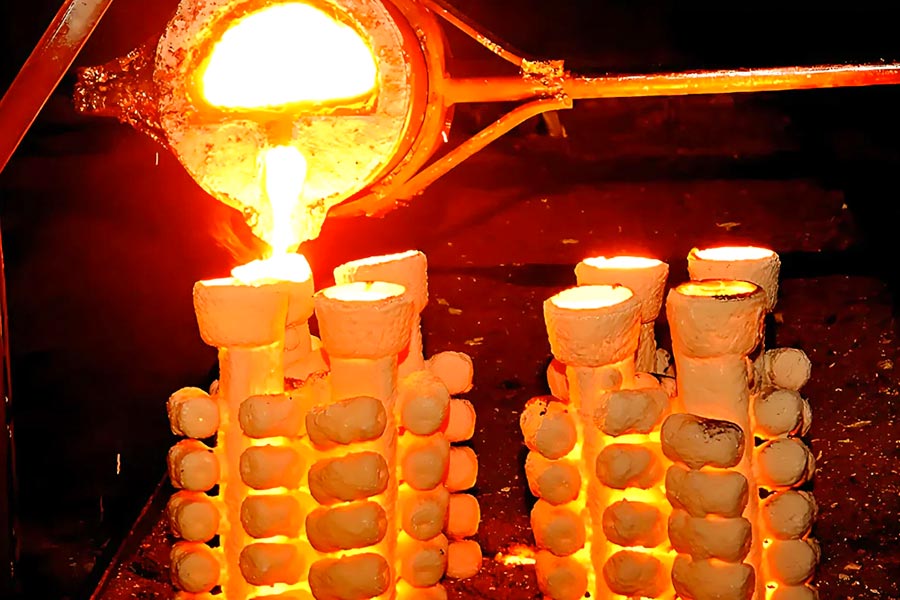
What plaster is used for metal casting?
In metal casting, the choice of plaster directly affects the quality of castings and the life of molds. The following are the types and characteristics of commonly used plaster:
1. α-type semi-hydrated plaster
After high temperature and high pressure refining, the crystals are dense, the compressive strength is 15-30MPa, the thermal expansion rate is <0.15%, and the refractoriness is 1200-1300℃. It is suitable for precision casting of high-temperature alloys such as titanium alloys and nickel-based alloys, as well as complex thin-walled parts such as aircraft engine blades, with a dimensional tolerance of ±0.2mm. Adding zirconium oxide or glass fiber can improve performance.
2. β-type semi-hydrated plaster
Dry calcination production, loose crystals, low cost, temperature resistance of 260-500℃, and compressive strength of 8-12MPa. It is used for small castings and rapid prototyping molds of low-melting-point metals such as tin and lead, and can reduce the defective rate with cold iron.
3. Modified composite plaster
(1) Foamed plaster
Physically foamed to form 20% – 30% pores, air permeability increased by 50%, compressive strength 10 – 12MPa, used for aluminum alloy automotive parts casting, can reduce pores, surface roughness Ra3.2μm.
(2) Reinforced plaster
Adding quartz sand and other modifications, temperature resistance exceeds 800℃, strong crack resistance, used for stainless steel art casting, mold life extended 20 times.
4. Key indicators for plaster selection
Temperature resistance | Select according to the melting point of the metal (such as titanium alloy needs to be >1200°C, aluminum alloy needs to be >700°C) |
Compressive strength | Precision casting needs to be ≥15MPa, and ordinary casting can be relaxed to 8-10MPa |
Expansion rate | High-precision parts require <0.2% (800°C test) to prevent dimensional deviation |
Air permeability: | Air permeability >0.5cm³/(cm²·min) can effectively reduce pores. |
5. Industrial Application Examples
α-plaster modified casting titanium alloy blades for aerospace, resistant to 1300℃, tolerance ±0.15mm; foamed plaster cast aluminum alloy cylinder heads for automobile manufacturing, cost reduction of 40%, yield of 95%; β-plaster composite silicone layer for jewelry, replicating 50μm pattern, demoulding efficiency increased by 3 times.
plaster should be selected according to metal type, precision and cost for metal casting: α-type is suitable for high temperature and high precision, β-type is used for low melting point and low cost requirements, and modified plaster takes into account both performance and cost. Combined with process optimization, production efficiency and casting quality can be improved.
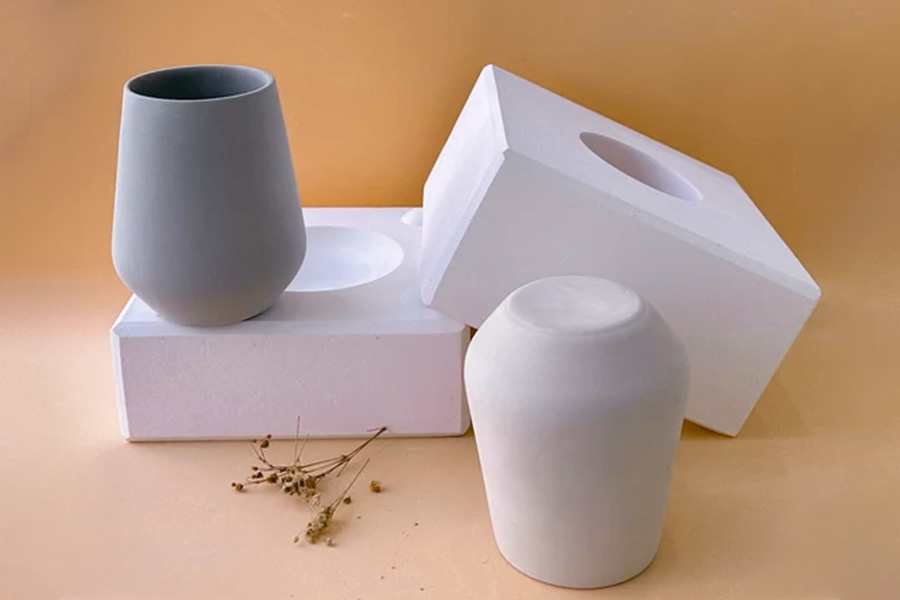
How Do Investment Casting Plasters Differ from Sand Casting Formulas?
In the casting process, the two plaster formulas are significantly different, which directly affects their performance and application. The following is a comparison from the three aspects of composition, performance and application.
1. Differences in formula composition
(1) Investment casting plaster
Using 45% zircon powder as the core material, it provides high fire resistance and low thermal expansion; the cementing material uses phosphate-modified plaster (fireproof grade A) that meets the JIS R5201 standard; supplemented with enhancers and stabilizers to optimize fluidity and precision.
(2) Sand casting plaster
Using 60%-70% quartz sand as the base material, it is low in cost and resistant to high temperatures; the binder uses α-hemihydrate plaster (compression resistance ≥15MPa) that meets the EN 13245 standard; adding bentonite or water glass to enhance strength and permeability.
2. Performance parameter comparison
(1) Investment casting plaster
800℃ linear expansion coefficient < 0.15%, ensuring dimensional stability; zircon powder refractory over 1600℃, suitable for complex thin-walled parts; must comply with JIS R5201 fireproof A grade standard.
(2) Sand casting plaster
Compression resistance ≥15MPa, meeting the mechanical requirements of large castings; quartz sand accounts for a high proportion, with obvious cost advantages; suitable for mass production of simple structure castings.
3. Differences in application scenarios
Investment casting plaster is used for precision casting in aerospace (such as turbine blades), medical devices (dental restorations), etc.; sand casting plaster is mostly used for the production of medium and large castings such as automotive parts and engineering machinery (engine blocks, gearboxes).
In summary, investment casting plaster focuses on high precision and low expansion, while sand casting plaster focuses on cost and strength. Enterprises need to choose the appropriate process and formula based on the complexity, budget and performance requirements of the casting.
Why Add Silicon Carbide to Aluminum Casting Plaster?
In aluminum alloy casting, silicon carbide (SiC) is added to the plaster formula as a functional additive to improve the quality of castings and production efficiency. The following is an explanation of the mechanism of action, formula optimization and application effect.
1. Core functions of silicon carbide
(1) Enhance thermal conductivity
Adding 15%-20% of 200 mesh silicon carbide to build a thermal conductivity network, the thermal conductivity is increased to 2.8W/m・K (ASTM D5470 standard), the solidification time of the casting is shortened by 22%, and the risk of shrinkage is reduced.
(2) Optimize the structure of the casting
Its uniform distribution improves the temperature field, refines the grains, reduces defects such as cold shuts and pores, and improves the surface finish and yield rate.
2. Side effect control and formula optimization
(1) Oxidation inhibition
Add 0.5% boric acid to adjust the pH to 9.5-10.2 to inhibit high-temperature oxidation of silicon carbide and avoid increasing the porosity of the plaster cavity.
(2) Scientific proportion
200 mesh silicon carbide balances dispersibility and thermal conductivity. The addition of 15%-20% takes into account both performance and cost, and is suitable for industrial production.
3. Practical application scenarios and effects
Suitable for casting of complex thin-walled parts such as aluminum alloy wheels and engine cylinder heads. After application, the mold turnover efficiency is improved by 18%-25%, the tensile strength of the casting is increased by 10%-15%, and the elongation is improved.
Adding silicon carbide to aluminum casting plaster can achieve a dual improvement in casting performance and efficiency by enhancing thermal conductivity and controlling defects. Scientific proportion and side effect control are the key to process stability.
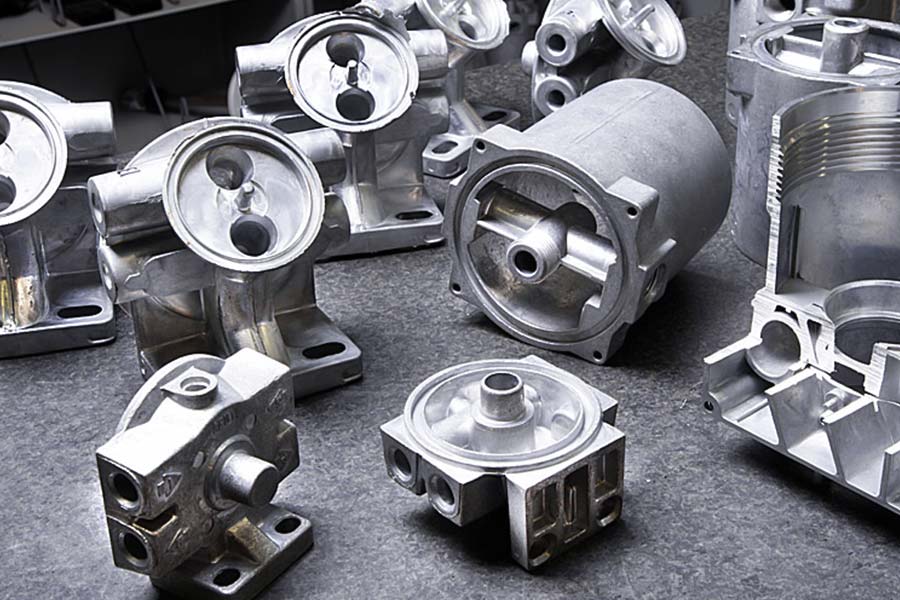
How to Optimize Plaster Mold Permeability Without Sacrificing Strength?
In metal casting, the permeability and strength of plaster molds often restrict each other, which can be synergistically improved through formulation and process optimization. The following is an explanation from the selection of foaming agent, vacuum mixing process and performance verification.
1. Foaming agent selection and microstructure control
Use sodium dodecyl sulfate (SDS) as a foaming agent, add 0.3%-0.5% according to ASTM D4258 standard to form a 50-200μm closed-cell structure with a porosity of 25%-30%. Pre-mix the foaming agent and plaster powder, control the water temperature to <25℃ to avoid bubble bursting.
2. Vacuum mixing process optimization
Set the vacuum degree – 0.08MPa, mix for 2-3 minutes, and make the bubble rate <3% according to EN 13814 standard. Vacuum degassing reduces >500μm defect holes and controls the mold density deviation by ±1.5%. Low speed (200-300rpm) stabilizes the pores, and high speed (800rpm) stirring for ≤30 seconds prevents the pore structure from being damaged.
3. Performance Verification and Industrial Application
After optimization, the air permeability of the mold is increased by 50% (0.8-1.2cm³/(cm²・min)), the porosity of the casting is less than 0.5%; the compressive strength is 12MPa, and it can be reused 5-8 times; the surface roughness of the casting is Ra3.2μm. A factory used it for aluminum alloy radiator molds, and the yield rate increased from 82% to 95%, the mold life was extended by 10 times, and the cost was reduced by 18%.
Scientific selection of foaming agents combined with vacuum stirring can balance the air permeability and strength of plaster molds. In the future, digitalization and new material technologies will promote casting accuracy and cost optimization.
How to Detect Residual Water in Cured Plaster Molds?
In the manufacture of plaster molds, residual moisture directly affects the casting quality – excessive moisture vaporizes at high temperatures, causing defects such as pores and rough surfaces in the castings. Controlling the moisture content (usually required to be less than 0.8%) through precise detection technology is the core link to ensure mold performance. The following details the quality control technology of residual water in plaster molds from three aspects: detection method, standard threshold and consequence analysis.
1. Core detection technology: accurate positioning of moisture content
Thermogravimetric analysis (TGA)
Principle and operation: Place the plaster sample in a constant temperature environment at 200°C and monitor its mass changes. After the water evaporates completely, the weight loss rate must be <0.8% (in line with ISO 11358 standard). If it exceeds this value, it is judged that the residual water exceeds the standard.
Advantages: The moisture content can be quantified with an accuracy of ±0.1%, which is suitable for laboratory-level quality control.
Infrared spectroscopy detection (FTIR)
Characteristic peak analysis: Detect the hydroxyl (-OH) absorption peak intensity at a wavelength of 3400cm⁻¹, and calculate the moisture content through the calibration curve. The threshold is usually set to absorbance <0.05, corresponding to a moisture content of ≤0.8%.
Applicable scenarios: Rapid online detection, support real-time monitoring of production lines, and a single detection takes <3 minutes.
Microwave moisture meter
Non-contact detection: Use microwaves to penetrate the plaster mold and infer the moisture content through the change of dielectric constant. The measurement range is 0.1%-5%, and the error is less than 0.2%.
Industrial application: Suitable for batch detection of large molds to avoid sampling and damage to the structure.
Consequences of excessive residual water: data-driven risk warning
Porosity surge: When the residual moisture is greater than 1%, the porosity of aluminum alloy castings soars from 0.5% to 2% (an increase of 300%), resulting in a decrease in mechanical properties;
Mold strength attenuation: Residual moisture makes the plaster crystal structure loose, the compressive strength drops from 15MPa to 8-10MPa, and the mold life is shortened by more than 50%;
Surface defects: The roughness of the casting deteriorates from Ra3.2μm to Ra12.5μm, increasing the post-processing cost by 20%-30%.
Industrial practice cases: detection optimization and yield improvement
An automotive parts factory introduced a TGA and infrared spectroscopy solution to achieve:
Water control: mold residual water dropped from 1.2% to 0.6%, and the casting porosity was stabilized below 0.3%;
Cost savings: The scrap rate due to defects dropped from 15% to 3%, saving more than 2 million yuan per year;
Efficiency improvement: Online infrared detection shortens the quality inspection cycle from 4 hours to 10 minutes.
Future trends: intelligence and multi-technology integration
AI prediction model: Through historical data training, the mold drying state is predicted in real time, and the drying parameters (such as temperature and duration) are optimized;
Multi-sensor integration: Combine temperature and humidity sensors with spectrometers to build a full-process moisture monitoring network with an accuracy of ±0.05%.
Accurately detecting residual water in plaster molds is the key to avoiding casting defects and improving yield. From laboratory-level TGA to production line infrared spectroscopy, combined with intelligent technology upgrades, an efficient and reliable quality control system can be built to provide a solid guarantee for high-precision casting.
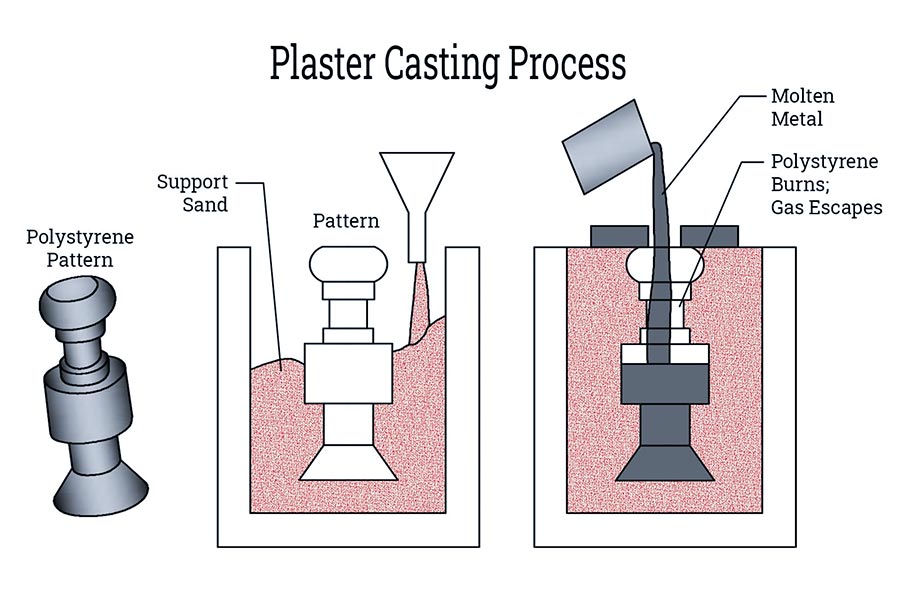
Why Combine Silicone with Plaster for Complex Geometries?
In precision casting and complex parts manufacturing, the composite mold technology of silicone and plaster is becoming a key solution to break through the bottleneck of traditional processes. By combining the flexibility of silicone and the rigidity of plaster, it can not only achieve micron-level detail reproduction, but also ensure the structural stability of the mold. It is especially suitable for fields such as jewelry and medical devices that require extremely high precision and demolding properties. The following analyzes its core advantages from three aspects: functional synergy, process parameters and typical applications.
1. Functional synergy: perfect balance between flexibility and rigidity
Precise replication capability of silicone layer
High-resolution replication: silicone (Shore A 40 hardness) can fill 50μm-level fine textures (such as jewelry relief, microporous structure), and the surface replication accuracy reaches ±0.02mm;
Elastic buffer: The 2mm thick silicone layer releases stress through elastic deformation during demolding to avoid damage to the fragile prototype by the hard mold.
Structural support of plaster matrix
Anti-deformation guarantee: The plaster shell (compressive strength ≥15MPa) provides rigid support for silicone to prevent deformation caused by injection molding or casting pressure;
Thermal stability: plaster has a temperature resistance of 300°C and can adapt to the needs of high-temperature resin curing or low-melting-point alloy casting.
2. Process innovation: demoulding efficiency and life improvement
Demolding optimization design
Drawing angle control: set a 45° draft angle, combined with silicone elasticity, to achieve zero-damage demoulding;
Nano release coating: spray fluorocarbon coating (friction coefficient <0.1) to reduce the adhesion between silicone and plaster, and extend the mold life to more than 50 times.
Composite mold production process
Layered molding: first pour silicone on the prototype surface, and then cover the plaster reinforcement layer after curing;
Vacuum degassing: use a -0.08MPa vacuum environment in the silicone layer molding stage to eliminate the influence of bubbles on texture reproduction.
3. Industrial application cases: double breakthroughs in precision and efficiency
Jewelry casting field
A jewelry manufacturer uses silicone-plaster composite molds to make 18K gold necklaces, achieving:
Detail restoration: 50μm-level plant textures are clearly reproduced, and the surface roughness reaches Ra0.8μm;
Demolding efficiency: the demolding time of a single piece is shortened from 15 minutes to 2 minutes, and the qualified rate is increased from 70% to 98%;
Cost control: the mold cost is reduced by 60% compared with the pure silicone solution, and it can be reused more than 30 times.
Medical device manufacturing
For the production of titanium alloy orthopedic implants (such as porous structure bone screws), the composite mold guarantees:
Micropore accuracy: pore diameter 200±10μm, porosity 65%-70%, meeting biomechanical requirements;
High temperature adaptability: the plaster layer withstands the titanium alloy casting temperature (1600°C), and the silicone layer safely decomposes after preheating.
The composite mold technology of silicone and plaster solves the contradiction between precision, strength and demoulding efficiency in the manufacture of complex geometric shapes through complementary material properties and process innovation. In the future, with the integration of new materials and digital technology, this solution will release greater potential in the field of high-end manufacturing.
What Surface Finishing Achieve Mirror Finishes on Plaster Castings?
To achieve the mirror effect of plaster castings, a multi-stage surface finishing process is required, combined with demoulding optimization and precision polishing technology. The following details the key methods from three aspects: pretreatment, polishing process and measured data.
1. Pretreatment stage: release agent optimization
(1) Application of alcohol-based release agent
Coating thickness: 3μm uniform spraying to form a low adhesion interface;
Performance index: contact angle>110°, reducing the contamination of the surface by demolding residue;
Core function: to ensure the smoothness of the base surface after demolding of the casting and avoid mechanical damage.
Ultrasonic cleaning: use anhydrous ethanol medium to remove micron-sized particles;
Drying control: 50°C constant temperature drying to prevent water stains from affecting subsequent polishing.
2. Precision polishing technology solution
(1) Nano-alumina polishing
Particle size selection: 50nm alumina suspension, with non-woven polishing wheel;
Roughness improvement: Ra value reduced from 3.2μm to 0.8μm (ISO 1302 standard test);
Process parameters: axial pressure 0.2MPa, speed 1200r/min, time 15min/piece.
(2) Electrolytic polishing enhancement (optional)
Electrolyte formula: phosphoric acid and propylene glycol mixture (ratio 3:1);
Micro-flatness: eliminate submicron scratches and improve reflective uniformity;
Applicable scenarios: surface finishing of high-precision optical devices or artistic castings.
3. Actual test cases and effect verification
Watch parts processing: After alcohol-based release + nano-polishing, the Ra value reaches 0.4μm mirror grade;
Defect control: surface porosity <0.01%, meeting the appearance standard of luxury goods;
Efficiency comparison: 40% of working hours are saved compared with traditional mechanical polishing, and the qualified rate is increased to 98%.
The coordinated application of alcohol-based release agents and nano-alumina polishing is the core path for plaster castings to achieve mirror effects. Enterprises need to select the appropriate process according to the precision requirements of castings, combine cleanliness control with parameter optimization, and break through the bottleneck of surface roughness.
Conclusion
The selection of plaster for metal casting needs to comprehensively consider the melting point of the metal, the precision of the casting and the process cost. From the high strength of α plaster to the rapid prototyping of foamed plaster, the combination of different formulas and processes provides diversified solutions for various industries. In the future, with the advancement of materials science, plaster casting will achieve greater breakthroughs in high precision and environmental performance.

📞 Phone: +86 185 6675 9667
📧 Email: info@longshengmfg.com
🌐 Website: https://www.longshengmfg.com/
Disclaimer
The content appearing on this webpage is for informational purposes only. LS makes no representation or warranty of any kind, be it expressed or implied, as to the accuracy, completeness, or validity of the information. Any performance parameters, geometric tolerances, specific design features, quality and types of materials, or processes should not be inferred to represent what will be delivered by third-party suppliers or manufacturers through LS’s network. Buyers seeking quotes for parts are responsible for defining the specific requirements for those parts. Please contact to our for more information.
Team LS
This article was written by various LS contributors. LS is a leading resource on manufacturing with CNC machining, sheet metal fabrication, 3D printing, injection molding,metal stamping and more.

FAQs
1. What is the best plaster?
In industrial applications, α-hemihydrate plaster is considered to be the best type of plaster. It has high purity, high strength (compressive strength can reach more than 40MPa) and excellent dimensional stability. It is particularly suitable for precision casting and high-end mold manufacturing. Its crystal structure is complete and its porosity is low, which can meet the stringent industrial requirements.
2. Can plaster be used on metal?
plaster can be directly applied to metal processing, especially in investment casting process. Metal casting molds can be made by specially formulated plaster mixtures. This type of plaster usually adds refractory materials such as zircon powder or alumina to improve high temperature resistance. It can withstand metal molten temperatures up to 1600°C without deformation.
3. What is used for metal casting?
Metal casting mainly uses specially modified plaster materials, which are usually mixed with refractory aggregates such as quartz sand, mullite or silicon carbide, and reinforcers are added to improve strength and heat resistance. Among them, α-hemihydrate plaster-based composite materials have become the preferred material for precision casting due to their excellent replication accuracy and thermal stability.
4. What is plaster used for?
As a multifunctional material, plaster is mainly used in the industry for precision casting mold manufacturing, which can produce metal parts with complex shapes; in the construction field, it is used to make decorative components and fireproof materials; in the medical industry, it is used to fix splints and dental models; in the art field, it is used for sculpture and handicraft production. Its excellent formability and processability make it widely used in various fields.


I really enjoy examining on this website , it contains great blog posts.
I really like your writing style, fantastic information, appreciate it for posting : D.
I must convey my gratitude for your kindness giving support to persons that need help on that situation. Your special dedication to passing the solution around ended up being rather useful and has truly encouraged girls just like me to achieve their goals. Your informative guide means much a person like me and somewhat more to my colleagues. Warm regards; from each one of us.