Resins, as an important class of polymers within the vast field of materials science, play a vital role in our daily lives and various industrial production fields. However, a common question is: is resin plastic? Many people often confuse resins with plastics, finding it difficult to distinguish them. Let’s delve deeper into the definition of resin, its properties, types, advantages and disadvantages, and wide-ranging applications of resins. We’ll also delve into the core differences between resin vs plastic to help you better understand this unique material and make informed choices.
What is Resin?
Resins, which can be classified as natural or synthetic, are a class of organic polymers. At room temperature, resins are mostly solid or semi-solid, insoluble in water but soluble in certain organic solvents. During processing, resins cure by heating or adding a curing agent. Phenolic and polyester resins are widely used in industries such as art, aerospace, and automotive manufacturing. Understanding the definition and classification of resins will help us better understand the difference between resins and plastics.
The unique properties of resin
- Strength and Hardness: The strength and hardness of different resin types vary significantly. For example, epoxy resin has excellent strength due to its high cross-link density.
- Lightweight: The resin’s low density makes it an indispensable material in the aerospace and automotive industries.
- Flexibility: Polyurethane resin has excellent flexibility due to its unique molecular structure.
- Biocompatibility: Some resins are safe for medical use due to their good compatibility with human tissue.
- Weather resistance: Different resins have different weather resistance properties, with acrylic resins exhibiting excellent light resistance.
- Corrosion resistance: Fluorocarbon resins are chemically stable and effectively resist corrosion from various chemicals.
- Processability: These resins have good plasticity and can be processed into products of various shapes and sizes.
- Thermoplastic resins vs. thermosetting resins: Some resins can be repeatedly softened and cured under certain conditions.
- Environmental friendliness: With the increasing awareness of environmental protection, the development of environmentally friendly resin products has become a new trend.
Physical properties of resin
- State: Resins exist in a variety of forms, including solid, liquid, and gel. Resin pellets are often used for processing.
- Color: Resins can come in a variety of colors, including transparent and opaque.
- Density: Resins are available in a wide variety of products, ranging from low to high density.
- Hardness: Hardness ranges widely, from soft to firm.
- Texture: Some resins feel smooth to the touch, while others are more viscous.
- Transparency: Transparency ranges from clear to opaque.
- Gloss: Some resin products have a shiny sheen.
- Thermal Conductivity: Generally speaking, resins have low thermal conductivity and good insulating properties.
- Electrical Insulation: This property makes them useful when reduced electrical conductivity is required.
- Melting Point: The melting point of a resin varies depending on its type and additives.
The chemical properties of the resin
- Polymerization: Resins are polymerized through specific chemical reactions, which is the core process of how resins are made.
- Crosslinking: Crosslinking can significantly enhance the strength and stability of resins.
- Solubility: Resins have varying solubility in different solvents.
- Reactivity: Resins can react with curing agents or catalysts, changing their properties.
- Chemical Resistance: Chemical resistance varies depending on the formulation and type of resin.
- Thermal Decomposition: Resins decompose at high temperatures.
- Oxidation Resistance: Some resins remain stable in oxidizing environments.
- Hygroscopicity: A resin’s hygroscopicity affects its dimensional stability and mechanical properties.
Type of resin
- Epoxy resin: Known for its high strength and durability, it’s widely used in industries like construction and electronics. Many people ask, what is epoxy resin? It’s a common, high-performance synthetic resin.
- Polyurethane resin: It offers excellent flexibility and is commonly used in products like shoe soles and sofas.
- Polyester resin: It has excellent mechanical properties and chemical resistance and is widely used in shipbuilding.
- Silicone: It offers excellent heat resistance and electrical insulation, and is often used for sealing electronic devices.
- Acrylic resin: It’s transparent and weather-resistant, and is often used in outdoor billboards.
- Phenolic resin: It offers excellent heat resistance and electrical insulation, making it an ideal material for electrical appliance casings.

Advantages of resin
- Corrosion resistance: After proper treatment, the corrosion protection performance of the resin is excellent.
- High strength: Resin has higher strength than traditional materials.
- Abrasion resistance: The resin has high hardness and good wear resistance.
- Insulation: In the electrical field, the insulating properties of resins play an important role.
- Processability: Various processing methods such as injection molding enable the resin to be made into a variety of products.
- Low cost: Overall, the cost of resins is relatively low.
- Lightweight: Resins are lighter in weight compared to materials such as metal and concrete.
Disadvantages of resin
- Flammability: Some resins are flammable and have certain safety hazards.
- Coating difficulty: When coating work, the resin surface is prone to problems such as bubbles.
- Difficulty of recycling: It is difficult to recycle resin waste.
- Brittleness: In general, the resin texture is brittle.
- Temperature sensitivity: Most resins are difficult to withstand high temperatures.
- UV sensitivity: With long-term exposure to ultraviolet light, the resin is susceptible to damage.
Uses of resin
- Medical and health: Absorbent resins are widely used in the medical field, such as diapers, wound dressings, etc.
- Coatings and varnishes: Resins are used as a substrate for coatings and varnishes to protect surfaces.
- Adhesives: Resins have excellent adhesion properties and are an important component of various adhesives.
- Plastic products: The production of many plastic products is inseparable from resins.
- Fibers: Resin fibers play an important role in the manufacture of textiles and synthetic leather.
- Electronics: used in the manufacture of various electronic components, such as circuit boards.
- Building materials: Resins are also key raw materials in architectural coatings and adhesives.
- Printing inks: Resins ensure that the ink adheres firmly to the printing surface.

What is Plastic?
In our daily lives, plastics can be found everywhere. From drinking water bottles to the casings of electronic products, we cannot do without them. So, what exactly is plastic? Plastic is essentially a synthetic or semi-synthetic material, the main component of which is polymer. It is not only lightweight, but also very durable and flexible. Most importantly, it has low production costs. These advantages have quickly led to the widespread use of plastics in various fields. Currently, the raw materials for the production of most modern plastics come from fossil fuels.

Unique properties of plastics
- Flexibility: Can be easily molded into various shapes, whether it is a large plastic water tank or a small and exquisite ornament.
- Durability: Wear-resistant and impact-resistant, like everyday plastic tables and chairs, not easily damaged by bumps and sun exposure.
- Lightweight: Conducive to transportation and packaging, can reduce the difficulty and cost of handling.
- Insulation: Good electrical insulation and thermal insulation, wire sheaths and insulation containers often use this property.
- Chemical resistance: Can resist most chemicals, laboratory reagent bottles are often made of plastic.
- Versatility: By adjusting the formula and process, it can meet different specific needs.
- Low cost: Suitable for large-scale production, favored by many companies.
- Waterproof: In pipes and outdoor equipment, it can effectively prevent moisture.
Physical properties of plastic
- Melting point: It varies according to different types of plastics, such as polyethylene and polypropylene have different melting points.
- Density: From low-density foam to high-density engineering plastics, the span is large.
- Stiffness: There are soft as plastic bags and hard as plastic cutting boards.
- Transparency: It can be transparent for beverage bottles, but also opaque for toy production.
- Permeability: Some plastics are permeable to gases and liquids, depending on the type.
Chemical properties of plastics
- Chemical resistance: It can store chemicals and resist acids and corrosive substances.
- Stability: Sensitive to temperature and light, easy to age at high temperature and exposure to sun.
- Flammability: Most of them are flammable and release harmful gases, so pay attention to fire prevention when using.
- Degradation: The rate of degradation depends on the type and environment, and some of them are refractory to degradation in the natural environment.
- Solubility: Different plastics have unique solubility properties in different solvents.
- Reactivity: Depending on the chemical composition, it reacts with other substances under certain conditions.
- Recyclability: Due to the complex composition, it is difficult to recycle.
Main types of plastic
1.General plastics:
- PE (polyethylene): Including HDPE, LDPE, etc.
- PP (polypropylene): High rigidity, heat resistance
- PVC (polyvinyl chloride): Two types of hard and soft
- PS (polystyrene): Transparent, easy to process
2.Engineering plastics:
- PA (nylon): Wear resistance, high strength
- PC (polycarbonate): Impact resistance, transparent
- POM (polyoxymethylene): High rigidity, low friction
- PET (polyethylene terephthalate): High mechanical strength
3.Special plastics:
- PTFE (polytetrafluoroethylene): High temperature resistance, low friction
- PEEK (polyetheretherketone): High temperature resistance, high strength
- PI (polyimide): Extreme environmental stability
advantages of plastic
Plastic materials offer significant advantages in a number of ways:
- Convenient processing: Suitable for injection molding, extrusion and other molding processes
- Light weight, high strength: The specific strength is better than most metal materials
- Design freedom: Complex geometries can be formed
- Cost-effective: The cost advantage of mass production is obvious
- Versatility: Special properties can be obtained through modification
- Corrosion resistance: Resistant to a variety of chemical media
- Insulation properties: Excellent electrical insulation properties
- Shock and noise reduction: Good damping characteristics
Disadvantages of plastic
There are also several restrictions on the use of plastic materials:
- Limited heat resistance: Long-term use temperatures are usually below 150°C
- Creep tendency: Prone to deformation under long-term load
- Aging problem: Reduced performance due to light, heat, and oxygen
- Recycling challenges: The sorting and recycling system is not yet perfect
- Dimensionally stable: High coefficient of thermal expansion
- Surface hardness: Most varieties are easy to be scratched
- Environmental concerns: Difficult degradation of traditional varieties

Uses of Plastic
- Packaging: Bottles, containers, bags, films.
- Construction: Pipes, insulation materials, windows.
- Automotive: Interior and exterior components.
- Electronics: Cables, connectors, insulators.
- Medical and Healthcare: Devices, equipment, packaging.
- Consumer Goods: Toys, kitchenware, appliances.
- Agriculture: Greenhouse films, irrigation pipes.
- Sports and Recreation: Equipment, protective gear.

Resin vs. Plastic: Core Differences
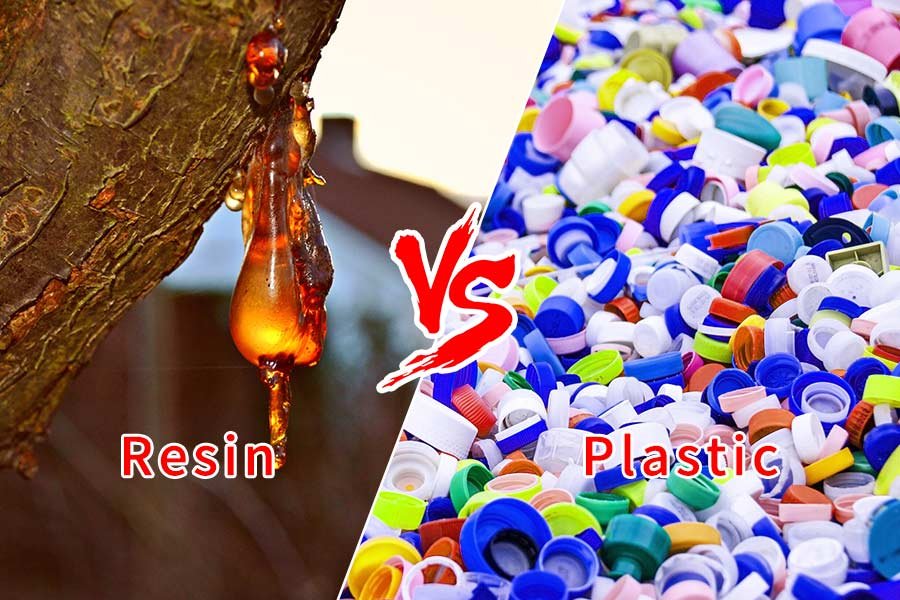
This is the key to understanding material selection. Is resin a plastic? The answer is not simple. While the primary component of plastic is resin, the two are not the same. Here is a clear comparison of the core differences between the two to help you understand the difference between resin and plastic:
| Contrast Dimensions | Resin | Plastic |
|---|---|---|
| Definition | High molecular polymer, in a broad sense, refers to the raw materials of plastic substrates | Plastic materials made of resin as the main component and plasticizers, fillers, etc. |
| Element | Natural resin (rosin, amber) or synthetic resin (polyethylene, polyvinyl chloride, etc.) | Resin (40%-100%) + additives (plasticizers, stabilizers, colorants, etc.) |
| Form | Liquid, semi-solid or solid when not processed; solidified after processing | The finished product is solid (thermoplastics can be repeatedly heated to soften, and thermosetting resins cannot be reshaped after solidification) |
| Processing method | Thermoplastic resins can be melted and processed, and thermosetting resins need to be solidified and molded | Injection molding, extrusion molding, blow molding and other processes |
| Physical properties | Corrosion resistance, good insulation, high strength (such as epoxy resin) | Lightweight, impact resistant, easy to shape, but poor heat resistance (most plastics are easy to deform at high temperatures) |
| Chemical properties | High chemical activity (uncured), stable after curing | Good chemical stability (some plastics have poor solvent resistance) |
| Thermal properties | Thermoplastic resins can be repeatedly heated to soften, and thermosetting resins are heat-resistant after curing | Thermoplastic plastics can be repeatedly processed, and thermosetting plastics cannot be reshaped after curing |
Typical uses |
Coatings, adhesives, electronic packaging, high-performance composite materials (such as carbon fiber resins) | Daily necessities (plastic bags, toys), industrial parts (safety helmets), packaging materials, medical equipment |
Environmental protection |
Natural resins are biodegradable, and some synthetic resins are difficult to degrade | Traditional plastics are difficult to degrade (“white pollution”), and degradable plastics are gradually developing |
| Cost | High-performance resins (such as epoxy resins) are more expensive | Low production cost, suitable for large-scale applications |
| Processing flexibility | Thermosetting resins cannot be reshaped after curing, while thermoplastic resins can be processed repeatedly | Thermoplastic plastics can be repeatedly heated and molded, suitable for the production of complex shapes |
| Typical product examples | Epoxy resin (paint), phenolic resin (bakelite), unsaturated polyester (fiberglass) | Polyethylene (plastic bags), polycarbonate (safety helmets), ABS plastic (electrical housings) |
Summary of Key Differences (Resin vs. Plastic Recap)
Definition and Composition: Resin is a base polymer material (natural or synthetic); plastic is a finished material made primarily from resin with various additives.
Processing Method: Resins (especially thermosets) typically cure via chemical reactions; plastics are primarily processed through physical molding techniques.
Form and State: Raw resins are often liquid or viscous; plastic raw materials are mostly solid pellets, and finished products are solid.
Key Properties: Resins (especially after curing) are generally harder, more heat-resistant, more chemically resistant, and may have better insulation properties; plastics are generally lighter, more resilient, and more impact-resistant, easier to form into complex shapes, and more cost-effective.
Applications: Resins are primarily used for bonding, sealing, coatings, and high-performance structural composites; plastics are primarily used to manufacture various finished products, particularly in packaging, consumer products, and industrial parts.
When to choose resin over plastic?
Understanding the fundamental difference between resin and plastic will help you make a better choice based on your application needs.Resin should be preferred over plastic in the following 7 situations:
- When high-strength bonding is required, such as structural bonding, resin-based adhesives (such as epoxy adhesives) typically offer far greater adhesion than the plastic itself.
- When operating temperatures exceed 150°C, high-performance thermosetting resins (such as polyimide (PI), phenolic resins, and certain epoxy resins) can withstand temperatures of 200-500°C or even higher, while most plastics will soften or deform after prolonged use below 150°C.
- Precision electronic packaging requires an extremely low coefficient of thermal expansion (CTE adjustable to <20ppm/°C) and excellent insulation and sealing properties. Epoxy and silicone resins are the preferred choices.
- For highly corrosive environments, fluorocarbon resins (such as PTFE) offer excellent resistance to strong acids (such as 98% concentrated sulfuric acid), strong bases, and solvents (annual corrosion rate <0.01mm).
- Ultra-thin coating applications: UV-curable resins can achieve ultra-thin, precision coatings on the 10μm level, while plastic spraying typically struggles to achieve uniform coatings below 100μm.
- Medical implant requirements: Extremely high biocompatibility is required (e.g., passing Level 0 cytotoxicity testing). Medical-grade silicone resins and specialized polyurethane resins are common choices.
- High-end surface treatment requirements: Resin coatings (e.g., polyurethane varnishes and epoxy flooring) must achieve a mirror-like gloss (GU > 95). Plastic surfaces are susceptible to weld lines, flow marks, and other issues.
Critical selection criteria: When applications demand high-temperature resistance, extreme strength, superior adhesion, excellent chemical resistance, high-precision packaging, or biocompatibility, high-performance resins should be prioritized, even at a higher cost. Resins are key materials in achieving these extreme properties.
When should you choose plastic over resin?
Plastics should be preferred over resins in the following situations:
- When large-scale production is required: Plastic injection molding, extrusion, and other processes are highly efficient, with short cycle times, making them suitable for high-volume manufacturing.
- Cost-sensitive products: The raw material price of general-purpose plastics (such as PP, PE, and PS) is typically significantly lower than that of high-performance resins (possibly only 1/3 to 1/2 the price).
- Require complex three-dimensional shapes: Plastic melts have good fluidity, making them ideal for manufacturing products with intricate structures and complex geometries through methods such as injection molding.
- For short-term or disposable products: For products such as packaging bags, food containers, and beverage bottles, plastics offer significant cost and convenience advantages.
- When recyclable materials are required: Thermoplastics (which make up the majority of plastics) can theoretically be repeatedly melted and reprocessed, and the recycling system is relatively mature (although practical challenges remain).
- Require high flexibility or impact resistance: Plastics such as PE, PP, and TPE generally have better toughness and impact resistance than most rigid resins.
- For durable consumer goods/industrial parts used in ambient temperatures: Plastics are stable within a temperature range of -40°C to 120°C, sufficient for most everyday and industrial applications.
Key to Selection: When the core requirements of an application are production efficiency, cost control, freedom of complex modeling, or recyclability, and the operating environment is within the conventional temperature range (-40°C to 120°C), plastic is a more economical and practical choice. It has unparalleled advantages in manufacturing final-form, high-volume products.
Choosing the Right CNC Machining Parts Factory
When looking for a CNC machining parts factory, there are quite a few things to look out for. First of all, it is necessary to examine the technical level of the factory in climb milling and conventional milling, especially multi-axis CNC machining technology. You know, a factory that specializes in high-precision CNC machining can make the machined parts have a smooth and flat surface and accurate dimensions. If you want to process parts made of aluminum, plastic, titanium, etc., it is best to choose a factory that is experienced in aluminum CNC machining, CNC plastic machining, and CNC titanium machining.
Take auto parts processing as an example, many auto parts have extremely high requirements for precision, not only the size is not bad, but the surface finish is also very critical. If you find a factory that is skilled in multi-axis CNC machining and high-precision machining, you can meet these requirements and produce high-quality parts.
Conclusion
Let’s return to the original core question: Is resin a plastic? The answer is no. Resin is different from plastic, but it is the core component of plastic. Resin is the basic high-molecular polymer raw material, while plastic is the final material created by adding various additives (plasticizers, fillers, stabilizers, etc.) to the resin to impart specific properties and shape.
Resin is an indispensable material in cutting-edge fields such as aerospace, electronic packaging, high-performance coatings, and medical due to its excellent stability, high strength, excellent temperature and corrosion resistance, and its ability to serve as a base material for adhesives and composite materials.
Plastics have profoundly impacted the modern packaging, consumer goods, automotive, and construction industries with their unparalleled ease of processing, cost-effectiveness, lightweight durability, and design freedom.
When selecting a material, it is important to balance practical needs (performance, environmental impact, cost) with environmental impact. For single-use packaging or everyday items, plastic is often a more economical and practical option. For products that must withstand extreme conditions, require the highest performance, or achieve specific functions (such as strong bonding or precision encapsulation), resins (especially high-performance synthetic resins) are often the only or best solution, even if it comes at a higher cost.
To achieve the best results for your resin or plastic processed products, it’s crucial to work with a professional processing partner. Choose a factory like LS that specializes in multi-axis CNC machining and high-precision CNC machining. They possess the expertise and extensive experience to precisely process a variety of materials, including aluminum, plastic, and titanium, solving complex machining challenges and ensuring that the quality and performance of your final product fully meet your requirements, whether you’re manufacturing precision resin-based composite parts or complex plastic functional components.

Contact us now to get exclusive CNC machining solutions!
📞 Phone: +86 185 6675 9667
📧 Email: info@longshengmfg.com
🌐 Website: https://www.longshengmfg.com/
FAQs
1. Is resin a plastic?
Not exactly. Resin is the main raw material (i.e., base polymer) of plastics. It is typically a liquid or solid, unprocessed material with increased hardness and corrosion resistance. Plastics are finished materials made by adding additives such as plasticizers and fillers to resins. They are easier to process, more flexible, and less expensive. The two are closely related, but resin is the raw material and plastic is the final product, resulting in fundamental differences in composition and application. Understanding this helps you choose the right material for manufacturing and design.
2. What are the main differences between resins and plastics?
The main differences lie in composition, form, and core properties. Resins are base polymers (natural or synthetic). As a raw material, they are usually liquid or solid. They are harder and more resistant to heat and corrosion, but they are more difficult to process. Plastics are finished products made by adding additives (such as plasticizers and fillers) to resins. They come in a variety of forms (such as pellets or finished products), are easier to shape, more flexible, and are more cost-effective, making them suitable for mass production. In short, resins are the “source” and plastics are the “derivatives.” They play different roles in materials science.
3. What is a resin?
What is a resin? A resin is a natural or synthetic organic polymer that can be solid, semi-solid, or liquid at room temperature. It forms a hard or tough material through a curing reaction (for example, by heating or adding a catalyst). It is an important raw material in the manufacture of plastics, coatings, adhesives, and composites. Resins offer high strength, chemical resistance, and insulating properties, making them widely used in industry, construction, and art. Simply put, they are the building blocks of polymer compounds, providing the core structure for a variety of finished materials.
4. What does “reain” mean when I search for it? Is it a spelling error?
Yes, “reain” is likely misspelled, similar to “resin.” In English, “resin” refers to a class of high-molecular-weight polymer materials commonly used in industries such as plastics and coatings. We recommend searching using the correct spelling of “resin” to obtain accurate information, such as the definition, types, and applications of resin. Spelling errors can lead to misleading results. Verifying your search results will help you find relevant technical information or product descriptions more efficiently.
Disclaimer
The content appearing on this webpage is for informational purposes only. LongSheng makes no representation or warranty of any kind, be it expressed or implied, as to the accuracy, completeness, or validity of the information. Any performance parameters, geometric tolerances, specific design features, quality and types of materials, or processes should not be inferred to represent what will be delivered by third-party suppliers or manufacturers through LongSheng’s network. Buyers seeking quotes for parts are responsible for defining the specific requirements for those parts. Please contact to our for more information.
Team LongSheng
This article was written by various LongSheng contributors. LongSheng is a leading resource on manufacturing with CNC machining, sheet metal fabrication, 3D printing, injection molding,metal stamping and more.


I was just looking for this info for some time. After 6 hours of continuous Googleing, at last I got it in your site. I wonder what’s the lack of Google strategy that do not rank this type of informative sites in top of the list. Usually the top websites are full of garbage.
Thank you for your attention, please subscribe to us and share valuable information with your friends in need, have any needs, please send us an inquiry.
Youre so cool! I dont suppose Ive read something like this before. So good to search out someone with some unique ideas on this subject. realy thank you for beginning this up. this web site is something that’s wanted on the net, someone with a little bit originality. helpful job for bringing something new to the internet!
There is evidently a bundle to know about this. I think you made certain nice points in features also.